



Silicon photonics boom continues: Taiwanese manufacturers ship GMT 1.6T optocoupler equipment, boosting domestic production.
Silicon photonics boom continues: Taiwanese manufacturers ship GMT 1.6T optocoupler equipment, boosting domestic production.
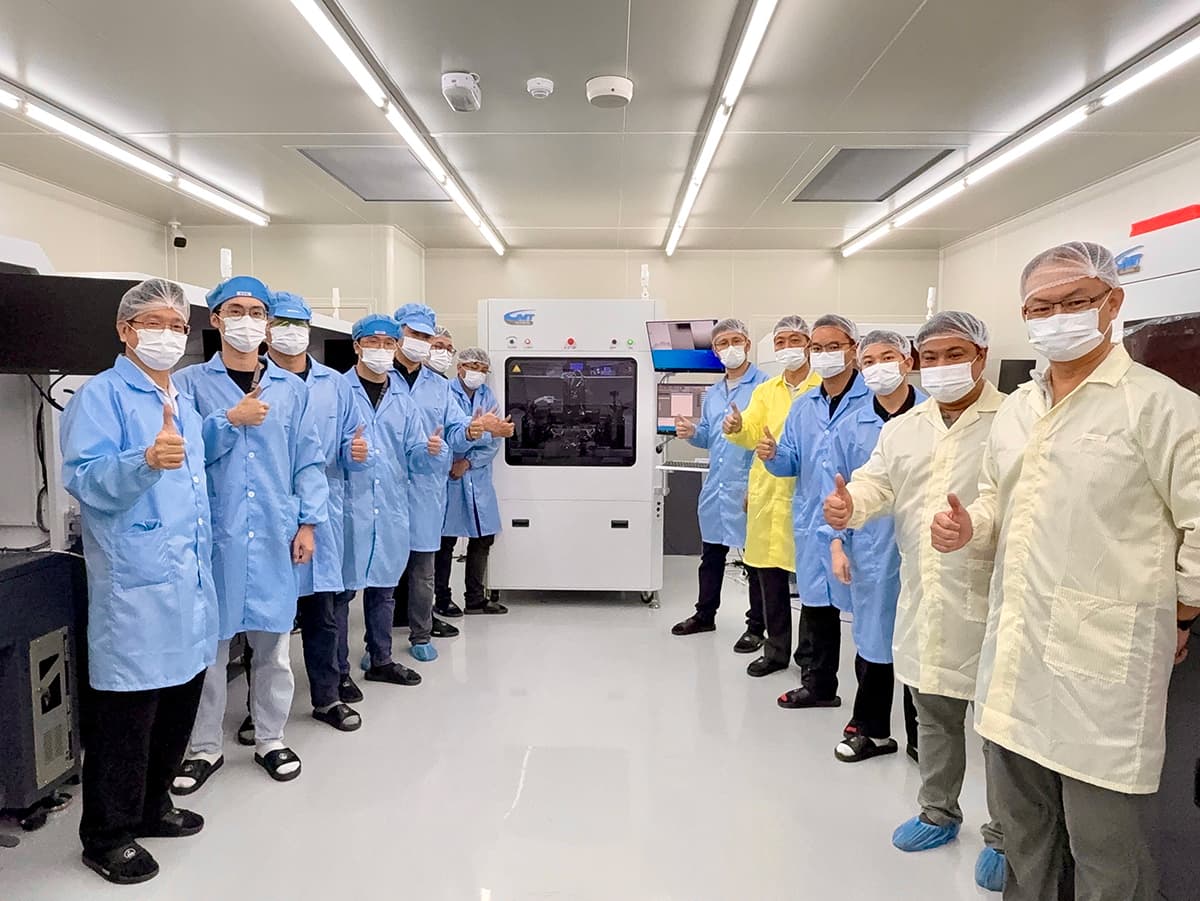
The Executive Yuan has officially launched the "Silicon Photonics National Team" project, jointly promoted by the Ministry of Economic Affairs and the National Science Council. It is expected to invest NT$2.9 billion between 2025 and 2028 to promote three major tasks: supply chain self-sufficiency, R&D environment construction, and technical talent cultivation.
The goal is to establish a domestically developed SiPh process and CPO testing and verification platform within four years, strengthening Taiwan's international competitiveness in AI and high-speed communications. Related companies, including Porositech, CSOT, WPS, and Win Semiconductors, will all benefit. Analysts point out that CPO is expected to become the mainstream high-speed interconnect after 2028, propelling the optical communications industry into a new phase.
In this wave of optoelectronic integration, the process precision and optical coupling capabilities of the equipment have become crucial for success. GMT recently launched 1.6T fully closed-loop active alignment machine is designed with "fully closed-loop active alignment × one machine with three modes (TX/RX/Dual Lens) × directly targeting SiPh-based optical transceiver module applications" as its core design, and is specifically designed for silicon photonics packaging and optical path coupling testing. This equipment combines visual servoing and optical power feedback control, which can continuously track and correct the optical axis during dynamic processes, maximizing the amount of optical coupling and ensuring convergent and repeatable results, significantly reducing packaging losses and calibration time.
The equipment has been verified and successfully delivered to multiple silicon photonics module manufacturers. It is mainly used for the coupling and assembly of SiPh optical transceiver modules and can support the 1.6T specification. In the future, it will be extended to the development and application of higher speed modules such as 3.2T and 6.4T.
GMT has already initiated its localization strategy, collaborating with local Taiwanese SiPh chip and packaging partners to vertically integrate design, manufacturing processes, and testing. High-precision silicon photonics packaging and testing facilities have been established at its Changhua headquarters and the ITRI Chung Hsing Campus. Moving forward, the company will continue to strengthen its algorithms, platforms, and error compensation technologies to support higher-speed specifications and CPO mass production environments, promoting the localization of key silicon photonics equipment.
Analysts believe that the mass production of CPO will reshape the global supply chain structure, encompassing chip design, silicon photonics (SiPh) processes, packaging and testing, and system integration. This involves companies such as NVIDIA, Broadcom, Marvell, TSMC, Tower, SiTerra, ASE, STARS, Infochip, Cisco, Foxconn, Sangfor, and Proway. Among these, the alignment accuracy and optical inspection capabilities of the optical coupling equipment are considered crucial to the success of mass production. The industry expects that as the adoption of CPO accelerates, shipments of related equipment will gradually increase.
Source: TechNewshttps://technews.tw/2025/11/03/ GMT -1/